When my husband and I felt an itch to disrupt our routine at the end of 2025, a trip to Florence, that most popular of tourist destinations, came immediately to mind, because winter seemed like the perfect time to go. In 2010, I had spent my first Christmas away from my family in Venice, where I was moved by the eerie, echoey emptiness of the cramped streets and the crumbling grandeur permeated by moody winter gloom. Yet, despite Venice feeling almost unpopulated in December, the museums were all open—an irresistible combination, and one I hoped to experience again in Florence. [1]
As an added benefit of traveling at New Year’s, our trip to Florence would coincide with the Fra Angelico exhibition taking place at the Palazzo Strozzi. Jason Farrago, a critic incapable of a limp-wristed review, had written glowingly of this once-in-a-generation show in the New York Times and, when I read his article, it had seemed impossible that I would be able to see it. But why not? If time and money allowed, why not?
So off to Florence we went.
As those better traveled than me know, Florence is still very much a living city, even in its historic center. While the crowds were thicker than in Venice, many of our fellow enjoyers of the city were Italians, which lent a festivity and ease to the throngs. Lingering over lunch felt de rigueur. Athleisure? Never heard of her. Whole families, from elders down to babies in strollers, seemed to be out enjoying the splendors of the city. It wasn’t the haunting experience I’d had in Venice, but it was lovely nonetheless. [2]
The Fra Angelico exhibition
On New Year’s Day, we went to the Palazzo Strozzi for Fra Angelico. The coffee I’d had no doubt upped my enthusiasm (I’m normally a tea drinker, but a cappuccino felt apropos), but the paintings themselves were also overwhelmingly gorgeous, especially en masse, and I found myself taken with the exhibition’s magnificence. It was a dreary morning and the lights in the show were dim aside from those aimed at the paintings, a display tactic that made the lavishly gilded panels sparkle.
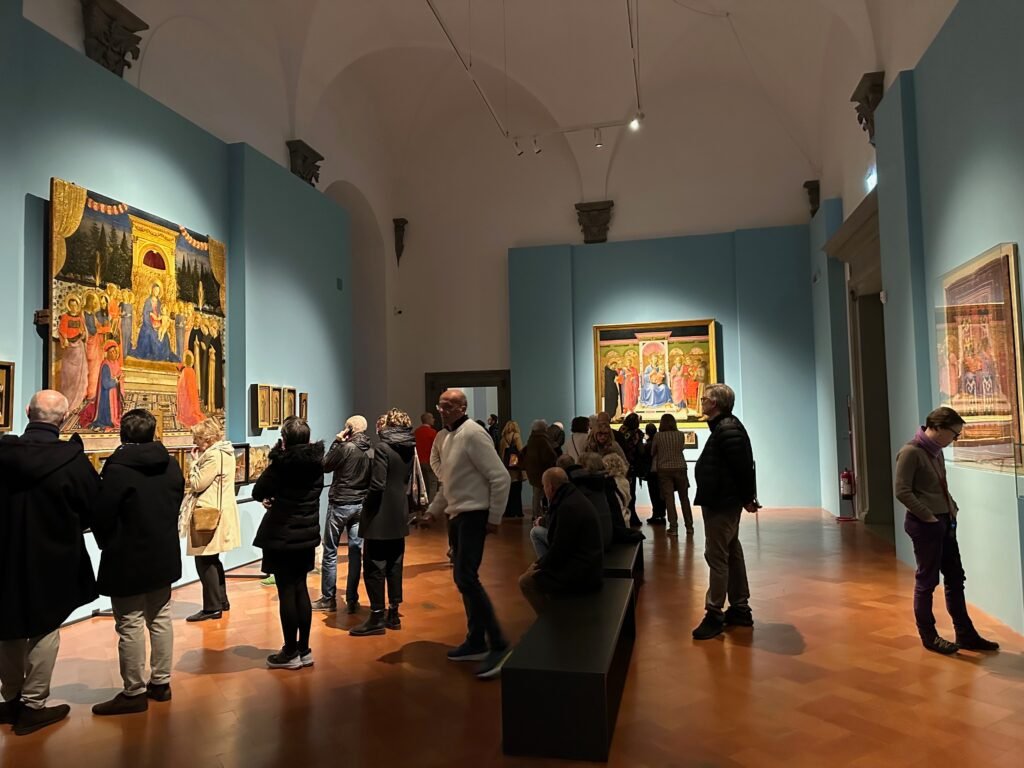
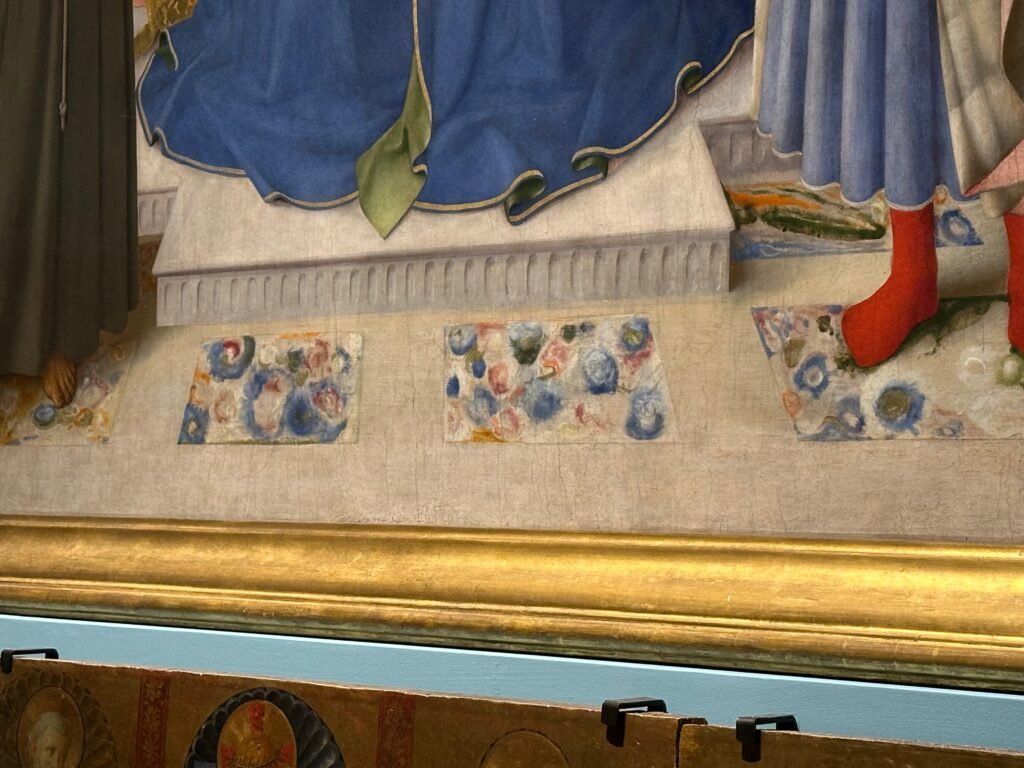
Fra Angelico’s color palette felt suitably divine: trippy rainbow-colored marbles, golden angel wings with peacock-like detailing, and strawberry-blonde hair on sweet-faced, rosy cheeked Virgins and solemn angels. Garments were painted in shades of green, pink, and blue, which lightened to pastels on the sides of bodies facing radiant figures like the Virgin and the Archangel Gabriel. Heads looked naturalistic and their owners’ bodies were modeled to appear dimensional, but they were equipped with unearthly golden haloes, round and flat behind their heads to communicate their significance beyond our fleshly, fallen, three-dimensional world.
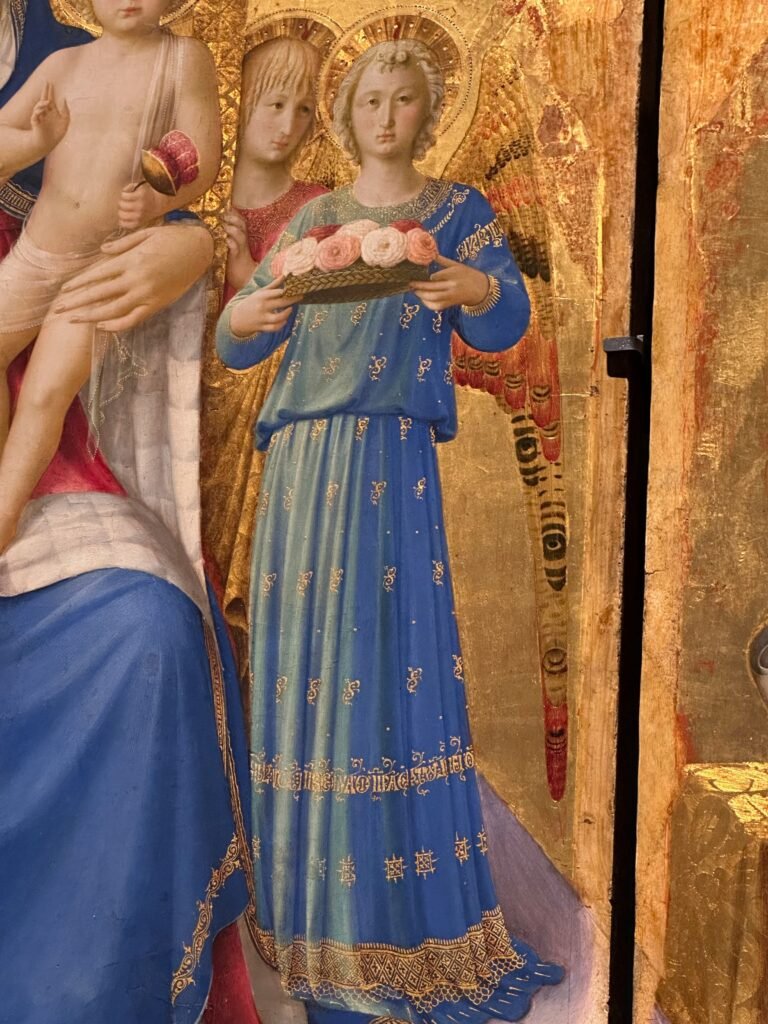
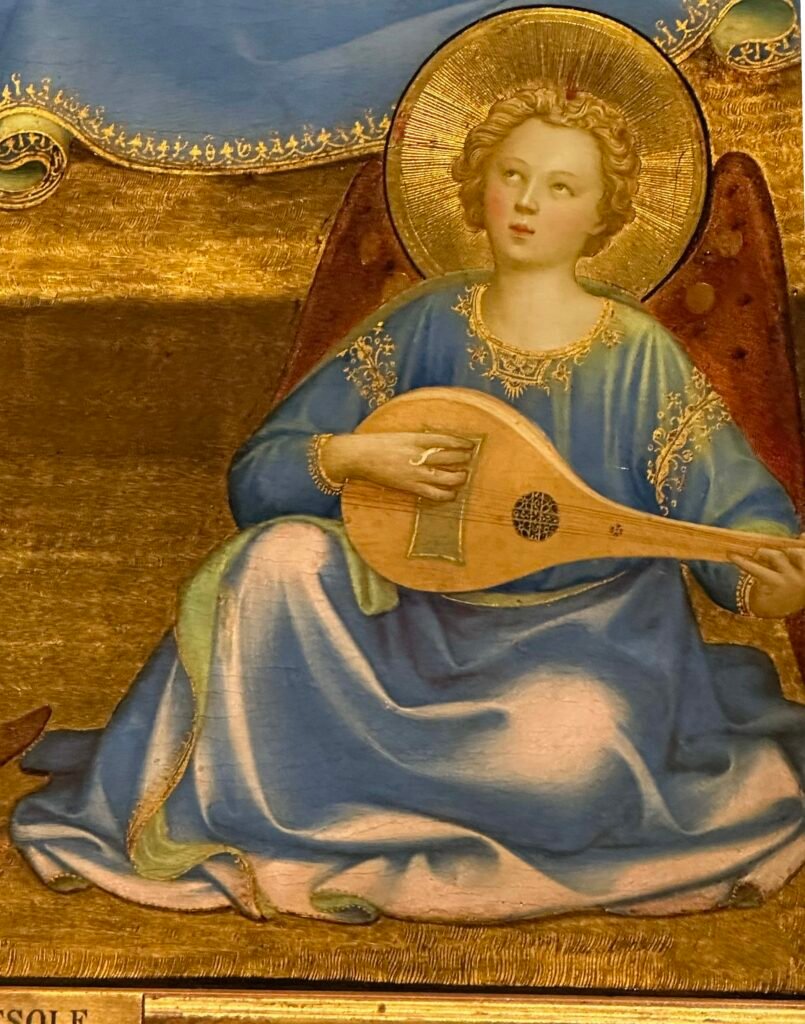
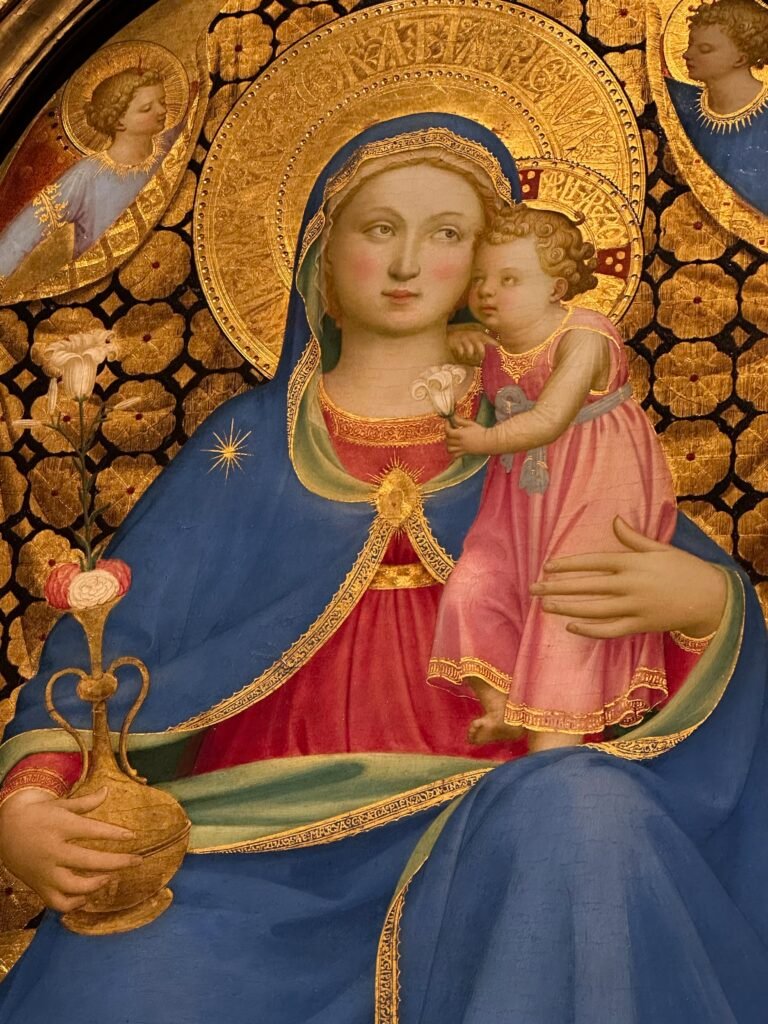
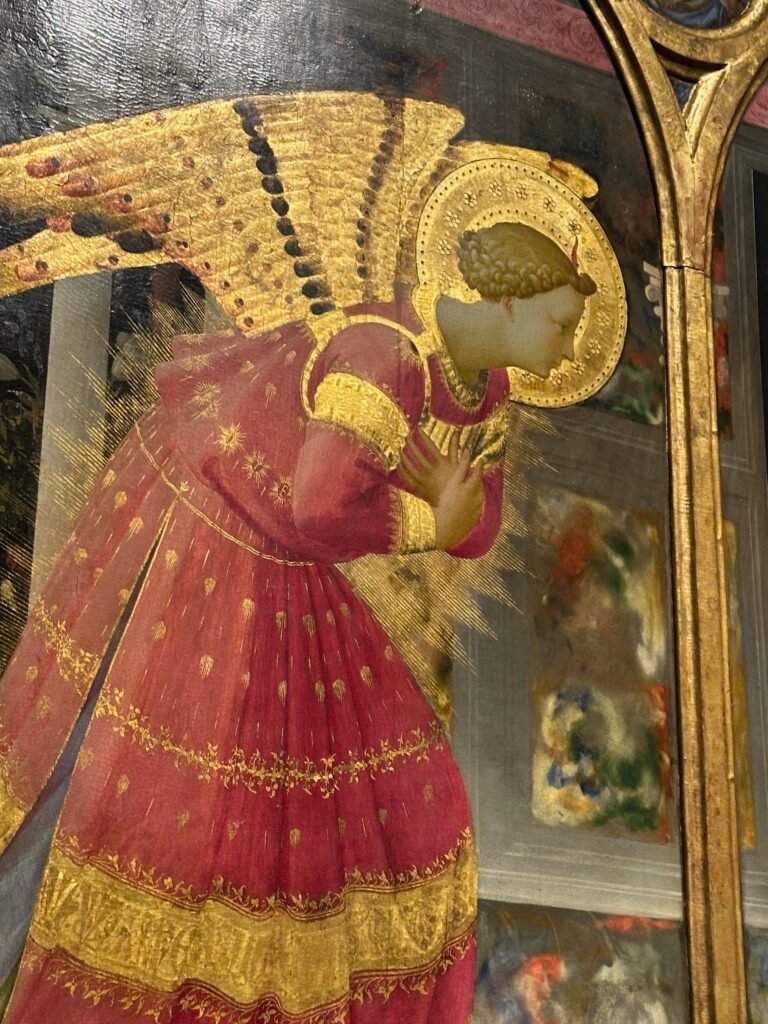
Even suffering felt contained to a reassuringly fleeting moment in time, because all that golden glory around those in torment proclaimed Christ’s promise of eternal salvation: they suffer now, but look, marvel, at what’s to come for them in heaven.
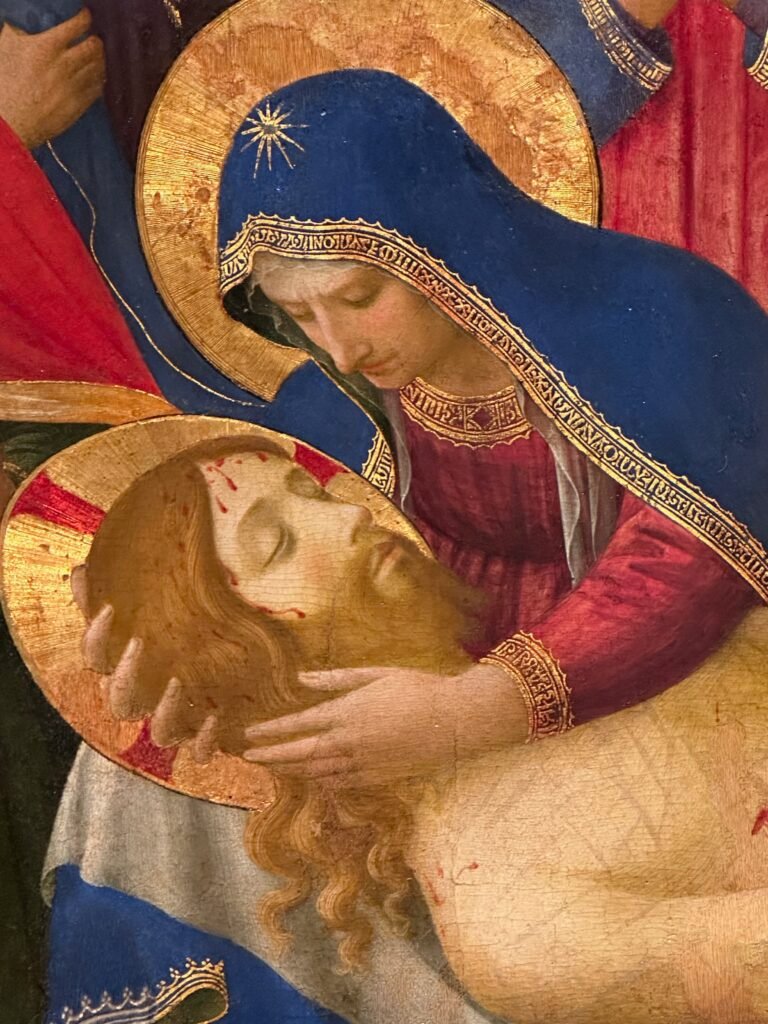
The paintings were a spectacular accomplishment, and completely in character for someone who had dedicated himself to God by joining a religious order. “Fra Angelico” is a nickname, an honorific bestowed upon the man born Guido di Pietro around 1395. When he entered the Dominican order, he took the name Fra Giovanni da Fiesole, aka “Friar John of Fiesole.” (Friars are akin to monks in that they have dedicated their lives to God, but they are part of mendicant orders, which believed that their members should go out into the world to preach and serve rather than being cloistered away.) The painter would thus have been referred to as Fra Giovanni in life; it was after his death—and as a tribute to his work—that he became known as “the angelic friar,” Fra Angelico.[3]
David Hockney’s Annunciation 2 (after Fra Angelico) at the Officina Profumo-Farmaceutica di Santa Maria Novella
While in Florence, my husband and I also visited the flagship location of the Officina Profumo-Farmaceutica di Santa Maria Novella, a pharmacy and perfumery founded by Dominican friars in 1221. (The perfumery has an outpost in NYC, but the beautiful, historic space in Florence is still worth a visit.)
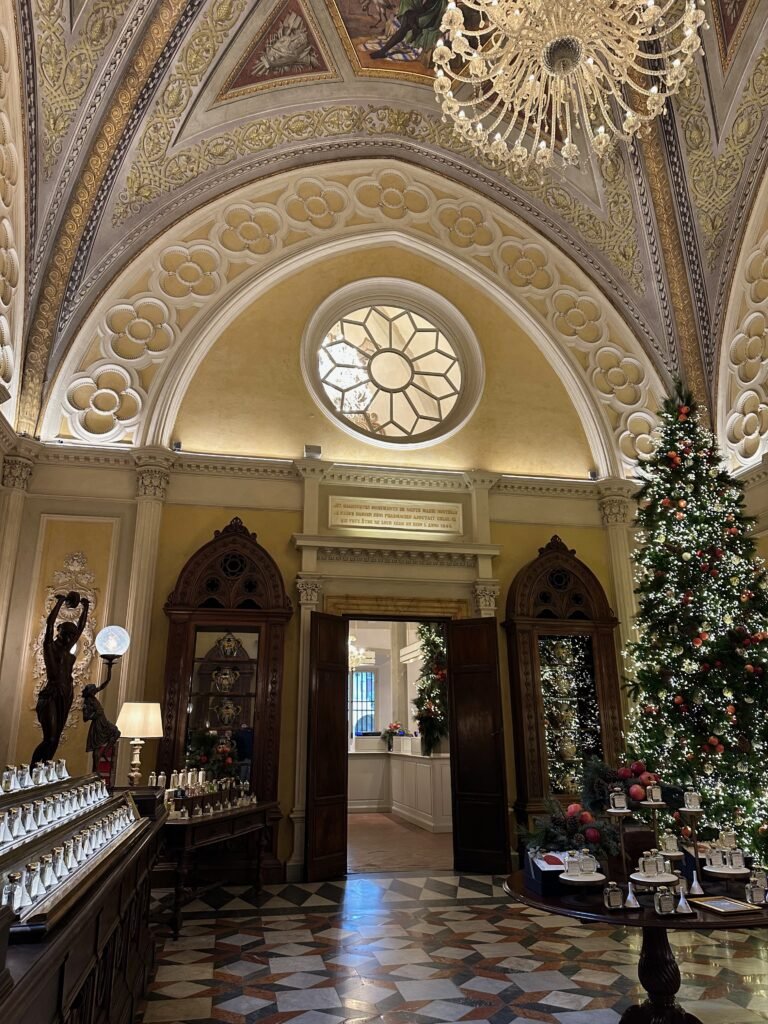
We were excited to discover that a small space off the entry hall (the original sacristy) held David Hockney’s Annunciation 2 (after Fra Angelico), which the artist had loaned for display in association with the Palazzo Strozzi’s Fra Angelico exhibition:
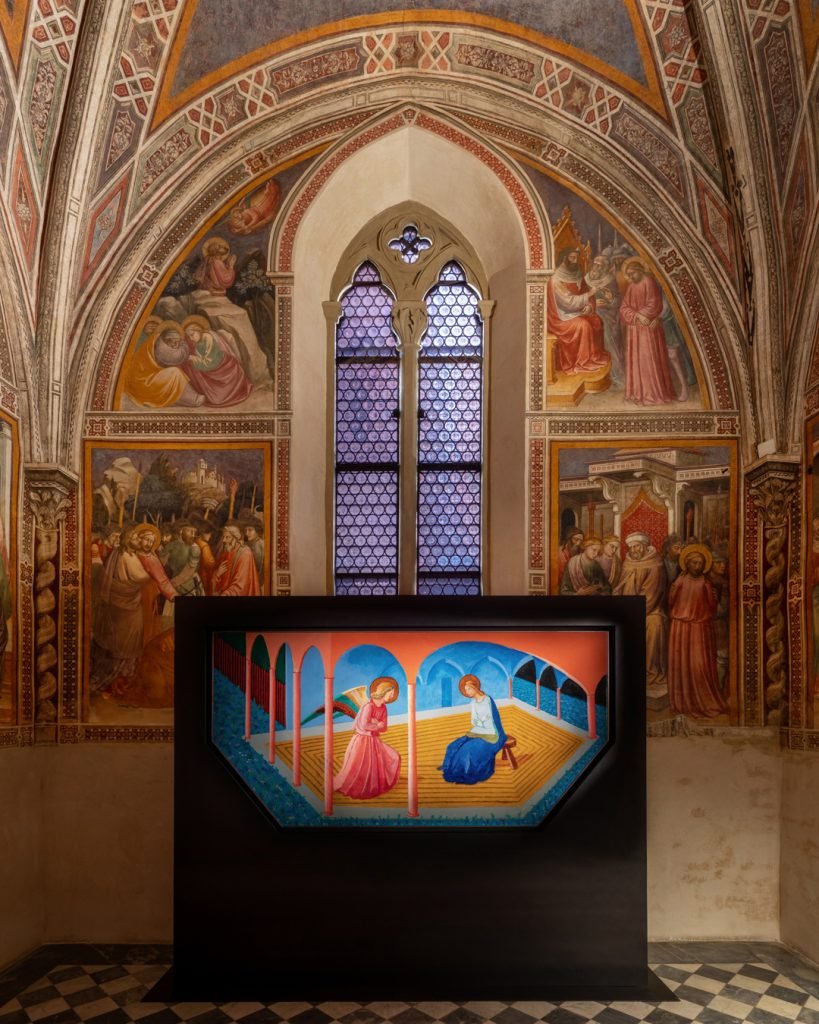
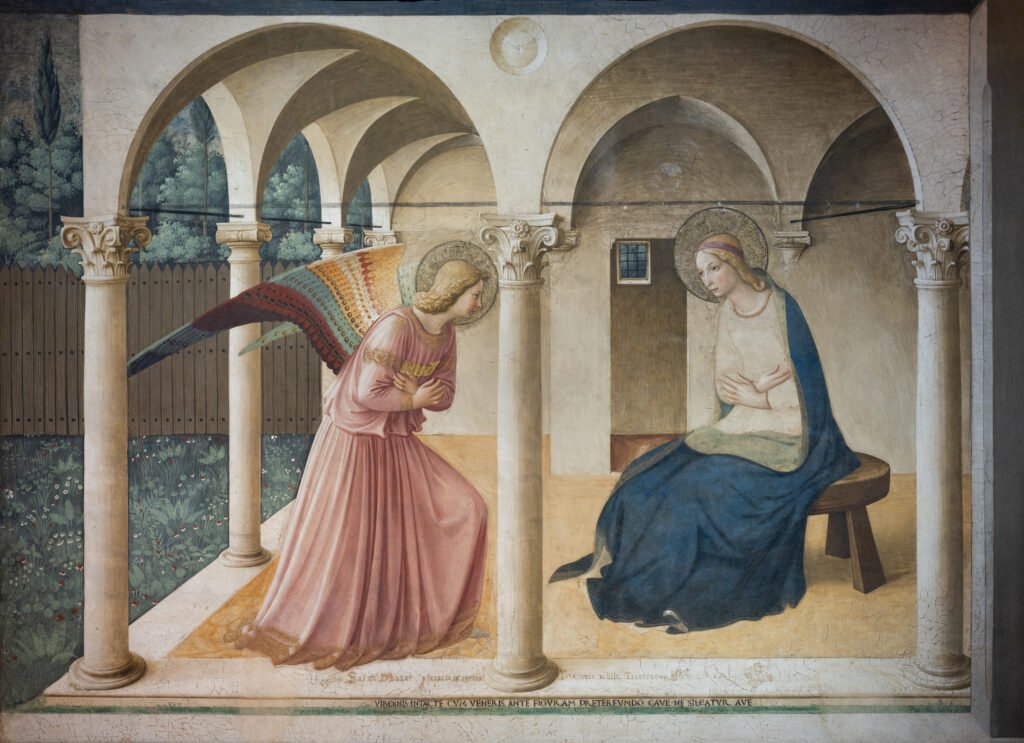
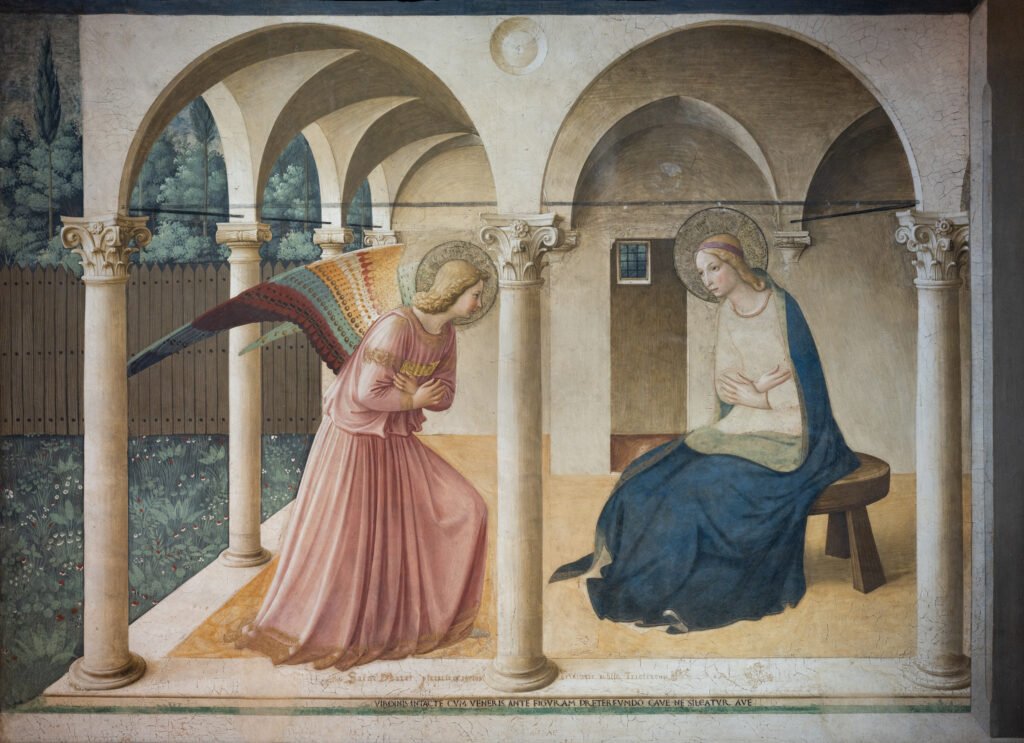
Hockney based the painting on Fra Angelico’s Annunciation fresco in one of the friars’ dormitory cells at the Convent of San Marco in Florence (a convent where Fra Angelico himself lived):

I enjoy Hockney’s work. What’s there to dislike? His British-by-way-of-California Pop Art sensibility goes down easy. And at this point, Hockney is an endearingly old man, an elder statesman of the art world. I admire his experiments with different mediums, right down to his iPad works. (They at first made me roll my eyes—I think everyone has their feelers out for digital hucksters these days—but, with more thought, there’s something appealing about an 80-something keeping up with the times and continuing to grow and experiment as an artist.)
All of this is just to say: I was excited to see a Hockney work inspired by Fra Angelico. But when I went into the sacristy, where Hockney’s painting was lit with the same drama as the works in the Palazzo Strozzi, I felt…thrown for a loop. A philistine desire to giggle stirred inside of me. Framing the Hockney painting was the sacristy itself, frescoed with scenes from Christ’s Passion painted by Mariotto di Nardo in ca. 1385–1408:
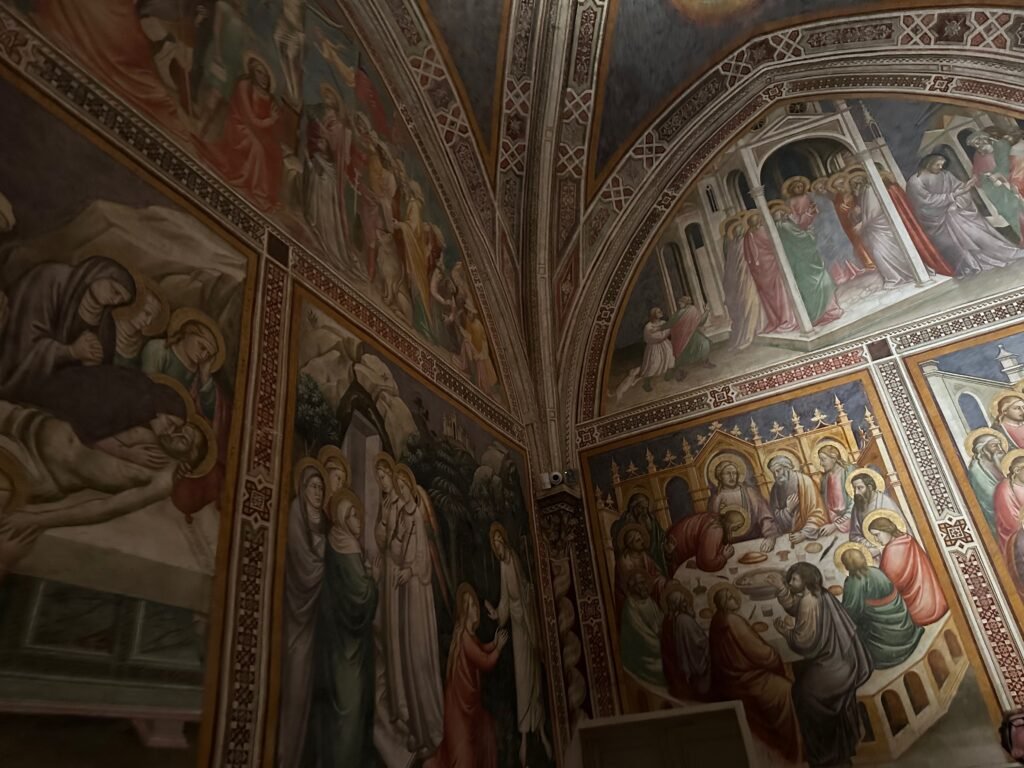
The exquisitely painted, enveloping quality of the room’s décor made Hockney’s painting feel small and hokey by comparison—or so I felt at first.
I’d like to add an aside here with a couple of facts about myself: despite getting a PhD in art history, my blue-collar, Appalachian origins mean I didn’t often experience “high culture”—including fine art—until I was old enough to seek it out for myself. The culture of my childhood was pop culture, shaped by what was on the radio and TV and in the books available to me. Some people grow up with parents who purposefully expose them to high culture, to things like fine art, dance, classical and experimental music, arthouse films. I imagine that, to these people, the etiquette of experiencing such work must feel natural. I, however, have had to learn to withhold quick judgment in favor of a drawn-out experience, to appreciate that beauty and naturalism are not inherently valuable, and that form can be secondary to concept.
To me, contemporary art often feels like an exercise in “the more you know”: if you’re having trouble engaging with it, you might just need to learn more about the idea behind it. (I suppose this is true of all art, but there’s something straightforward about the early modern/Renaissance interest in naturalism that makes it feel more approachable.) In any case, the thinking behind David Hockney’s Annunciation 2, as described by Lawrence Weschler in an essay from 2018, has given me a greater appreciation for the painting.
Hockney and the “paralyzed cyclops”
From Weschler’s text, I learned that Hockney produced Annunciation 2 (top row, third image on Hockney’s website) as part of his interest in “reverse perspective,” which he has explored as an alternative to the one-point perspective we find in Fra Angelico’s original Annunciation fresco.
(I wanted to post pictures of Hockney’s works here but they are under copyright, so I’ve included links to them on his website. You can also see illustrations of all the paintings in question in Weschler’s article, albeit at small size and resolution.)
Hockney has long felt that, while we have grown accustomed to the world being presented to us in single-point perspective—art from the Renaissance onward has tended to use single-point perspective as the default, and this perspective is inherent to the nature of photography—one-point perspective doesn’t adequately capture our lived experience of the world. Single-point perspective, after all, is the view from one eye (or camera lens) and we have binocular vision. The system also only works effectively if you view the image from the appropriate location in front of it. Likewise, one-point perspective relies on a single moment in time and therefore isn’t up to the challenge of capturing the dimensionality of a world experienced through movement and prolonged durations. In Hockney’s vivid parlance, “Photography is all right, if you don’t mind looking at the world from the point of view of a paralyzed cyclops, for a split second.” [4]
According to Weschler, Hockney long sought to capture the “capacious spaciousness” of his porch and backyard in L.A. but struggled to do so with single-point perspective. [5] Some examples appear in the top row, sixth image, and second row, second image, here.
Hockney was better pleased with the outcome when he painted the scene in reverse perspective (top row, fifth image). To take his interpretation a step further, he had his assistants construct hexagonal canvases, which built the scene’s reverse perspective into the support itself (top row, first image).
This hexagonal painting of his backyard launched Hockney into a series of works in reverse perspective on six-sided canvases. First, he painted a scene of two tables with vases of flowers (top row, fourth image). The angle of the flowers—one bouquet standing upright while the other leans away—called to mind scenes of the Annunciation, when the angel Gabriel appears to the Virgin Mary to tell her that she will miraculously bear the Christ Child. Specifically, it reminded Hockney of Fra Angelico’s San Marco fresco of the Annunciation, a poster of which had hung in the hallway of his childhood primary school. Hockney translated the scene into reverse perspective in his own version, creating the painting I encountered at Santa Maria Novella perfumery (first row, third image). [6]
Wechsler seems to feel obliged to explain why Hockney’s painting pales in comparison to Fra Angelico’s. Hockney “knocked off that version in just a few days,” Wechsler states, and in a parenthetical adds that Hockney “was obviously not trying to match the sublimities of Fra Angelico, but rather to experiment with fresh ways of rendering space, while paying evident homage to the master, especially in the tenderness of his treatment of the messenger and the virgin and the palpable regard between them…” [7]
Ah, okay. I get it now. Because of the way the Hockney painting was presented—in association with the Fra Angelico exhibition, set among Mariotto di Nardo’s Passion frescoes—I was attempting to receive it in the same register: as religious art, made by and for Christians, with one of its primary functions being to convey Christian story and doctrine. But to approach the Hockney this way does it a disservice, because, to Hockney, the religious content of the work is of secondary interest to the perspectival system undergirding it.
Hmm.
Here I remind myself: it’s okay not to like everything.
Or, more accurately, it’s okay to admit that art often shines brightest in a certain context.
Hockney, I think, belongs in the museum and the gallery, in the white box or the acid-green box (wow, that was a choice), but in any case, in spaces better suited to the weakened God of our post-Enlightenment world. What I wanted—and what I got from the exhibition at the Palazzo Strozzi—was an old-school reveling in God the divine, in art-making and viewing as forms of devotion. Hockney’s work is captivating…in a different context. Wechsler’s essay deserves a full read, because Hockney is right: the Renaissance ascendance of single-point perspective and its subsequent domination is fascinating. It’s just that, with my expectations set by Fra Angelico (and totally wooed by the other medieval and Renaissance wonders of Florence), I wasn’t in the proper mindset for this mischievously intellectual, contemporary Brit.
NOTES
[1] In the years since, I’ve come to feel a touch of guilt for how much I enjoyed the unpopulated, haunted vibes of Christmas-time Venice. It felt like that because of people like me: tourists, who pour into the city in droves each spring through fall, hollowing out space for themselves in the old part of the city with the power of their dollars and yuan. Venetians now mostly live outside the old city, across the lagoon on the less-historic-but-more-affordable mainland. Living paycheck to paycheck while teaching English in Prague, I had taken a cheap overnight bus down through the Alps to spend my precious time off in Venice with my Germany-based boyfriend. The bus was packed, no seat unfilled. We crossed the Alps in darkness, a somnolent gathering of what seemed to be mostly Italians going home for the holidays. At some point, our Czech bus driver, who had thrown a bit of English in here and there, swapped places with an Italian, who made no such effort. When morning rolled around and it became clear that we were in Italy and surely approaching Venice soon, my kind seatmate, an Italian, told me that he would let me know when it was time for me to get off the bus, in case I couldn’t parse the bus driver’s announcements. He was the first to explain to me that most Venetians now no longer lived in the part of the city that I would be visiting. It registered and it didn’t; I had never felt so poor and thinly stretched as I did in that chapter of my life—a country bumpkin alone abroad, overworked, underpaid, often sick (I taught lots of children), and desperate not to ask my parents for help—which made me feel somehow superior to my fellow tourists. I wasn’t, of course. With more years under my belt, I can appreciate the risks I was able to take because of the safety net derived from my parents’ ascent into the American middle class. While I wasn’t a classic gap-year backpacker, parsimoniously spending a stipend from daddy, an honest assessment of the situation requires acknowledging that my situation was not as precarious as it felt. Precarity as a justification for participating in overtourism feels like comparing apples and oranges anyway. I suppose I just felt long suffering and deserving of pleasure, but that was all internal arithmetic.
[2] On New Year’s Eve, I could hardly believe the number of fireworks being set off in the streets. At the restaurant where we rang in the New Year, the waiters lit a Roman candle in the building’s courtyard. Later, on the way back to the hotel, people were setting off their own fireworks in the piazzas and sometimes in the middle of streets; we even came across a small fire in the middle of the Via degli Speziali, perhaps the remnants of an amateur fireworks show we had just missed. This, I felt, could only be the behavior of locals. Who else would know where to buy fireworks? And having set aside so much money, travel, and time to be there to take in the city, it felt to me that only those who could take the city for granted would risk accidentally setting fire to any one of those centuries-old buildings, which all seemed to contain something significant, ancient, and beautiful. It felt small to feel annoyed at the risk of fireworks, though. It was a reminder, really, that Florence lives, it isn’t some kind of mile-wide museum, even if it feels like that to an American, unaccustomed to existing among so much celebrated history.
[3] Ross Finocchio, “Fra Angelico (Guido di Pietro) (ca. 1395–1455),” in Heilbrunn Timeline of Art History, Metropolitan Museum of Art, posted Oct. 1, 2006, https://www.metmuseum.org/essays/fra-angelico-guido-di-pietro-ca-1395-1455.
[4] Lawrence Weschler, “On Not Cutting Corners,” in David Hockney: Something New in Painting (and Photography) [and even Printing] (Pace Publishing, 2018), 7, https://www.lawrenceweschler.com/library/article/coming-soon-david-hockney-cutting-corners-at-pace.
[5] Weschler, “On Not Cutting Corners,” 4.
[6] Weschler, “On Not Cutting Corners,” 5–9.
[7] Weschler, “On Not Cutting Corners,” 9.