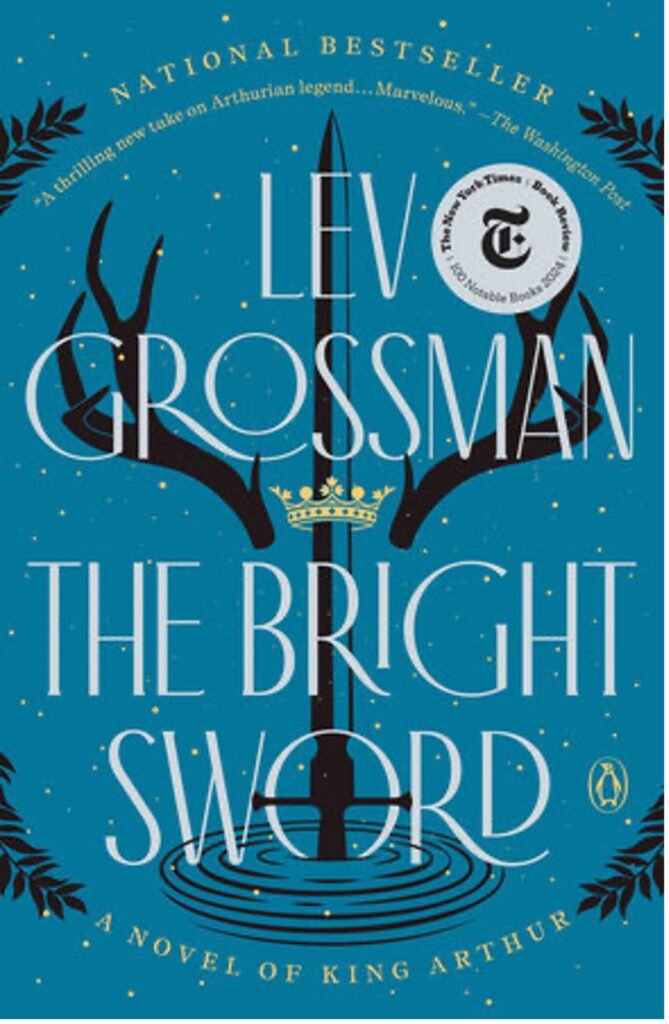
I love a high-quality fantasy novel, so I couldn’t believe my luck when Lev Grossman’s newest book, The Bright Sword, turned out to be a 700-page epic set in the world of King Arthur.
books/554241/the-bright-sword-by-lev-grossman/
The Bright Sword centers on Collum, an orphan and a bastard who grows up as the abused ward of the lord of Mull, an island in remote Scotland. As a boy, Collum finds hope in stories of King Arthur and his Knights of the Round Table. When his mistreatment finally becomes too much to bear, Collum steals his liege’s armor and travels to Camelot, seeking a leader and a cause worth fighting for.
He arrives too late, however: Arthur and most of his knights are dead or missing, and Arthur’s enemies, both human and fey, are threatening to tear the kingdom apart and push Britain back into the violence and disorder that have encroached since the Romans departed.
To stabilize the kingdom, Collum, a few surviving knights, and the sorceress Nimue set out on a quest to find the next king. Along the way they wrestle with all the powers that be, from their fellow men to the recently introduced Christian God, to Britain’s ancient gods and fairies.
Grossman’s erudition and writing style elevate the book from genre fluff to literature. The language is beautiful and evocative, and, although his characters live in a world drenched with magic and mysticism, they operate like real human beings, capable of honor and love but also cruelty, selfishness, and fanaticism.
Which brings me, at last, to the focus of this post: “acedia.”
acedia /ə’sēdēə/ (ah-see-dee-uh)
I know I must have stumbled across the word “acedia” while doing my PhD, given that I studied late medieval Europe, but, after The Bright Sword, I realized I hadn’t properly appreciated its nuances. (Although, as anyone who has done a PhD knows, acedia is one of the most common emotional states that doctoral students experience. In other words: getting a PhD often kind of sucks.)
Aaaanyway.
“Acedia” first appears on p. 29 of The Bright Sword (Penguin Books, 2024), where Grossman describes the despair that Collum falls into during his childhood after years of soul-crushing abuse:
He didn’t even dream of freedom, or rebellion, or revenge. He despised himself as much as they despised him. Collum worked and ate and slept at the bottom of a dark ocean of misery, head down, lost in the depths where no light reached him. He felt like the weight of it all would crush him. Father Conall called this listless despair acedia and he told Collum it was a sin. If it was, then Collum sinned and sinned and couldn’t stop sinning.
“Listless despair,” huh? I’ve known a thing or two about that, even if I’m fortunate to have never suffered like Collum. I immediately headed to Google to see what else I could find about the word, which was where I discovered that acedia is one of the Seven Deadly Sins, although the word “sloth” is most often used for this sin in English.
Sloth! How misleading. Sloth and listless despair are not the same thing—acedia is more like sloth as an outcome of despair. Merriam-Webster defines acedia as “apathy, boredom,” but digging a little deeper suggests a meaning more like “ennui” or “depression.”
Scrolling down the Merriam-Webster page brings one to the word’s etymology:
Borrowed from Medieval Latin acēdia “apathy, torpor, sloth,” borrowed from Late Greek akēdía “negligence, apathy,” going back to Greek akḗdeia “carelessness, indifference”…
So “acedia” was in use in Medieval Latin before it was adopted into English. What were the nuances of the word then? For this, we can turn to Thomas Aquinas.
Aquinas (ca. 1225–1274), one of the Middle Age’s most influential Christian scholars, writes about the dangers of acedia in his famous text the Summa Theologiae. To an English speaker, this Latin title sounds like “summary of theology,” and that’s basically what it is. Aquinas wrote it as a reference work for his fellow clergymen, and in it, he lays out the Church’s theology and explains it.1 According to Aquinas, acedia is “a kind of sorrow,” and this oppressive sorrow “so weighs upon man’s mind, that he wants to do nothing.” 2 So, in the Middle Ages, acedia has the valence of sloth, but it already means a kind of sloth rooted in despair.
In a 1923 essay called “Accidie” (an alternative spelling of acedia), Aldous Huxley (of Brave New World fame) explains how medieval monks feared falling into despair in moments of boredom, a sin that was as likely to plague a person in the middle of the day as the middle of the night, earning it the name dæmon meridianus, or the “noonday demon.” Huxley writes,
He [the noonday demon] would lie in wait for monks grown weary with working in the oppressive heat, seizing a moment of weakness to force an entrance into their hearts. And once installed there, what havoc he wrought! For suddenly it would seem to the poor victim that the day was intolerably long and life desolatingly empty. He would go to the door of his cell and look up at the sun and ask himself if a new Joshua had arrested it midway up the heavens. Then he would go back into the shade and wonder what good he was doing in that cell or if there was any object in existence. Then he would look at the sun again and find it indubitably stationary, and the hour of the communal repast of the evening as remote as ever. And he would go back to his meditations, to sink, sink through disgust and lassitude into the black depths of despair and hopeless unbelief. When that happened the demon smiled and took his departure, conscious that he had done a good morning’s work.3
Many early modern depictions of acedia/sloth make it clear that something sinister is at play. Consider, for example, these scenes from Sloth, a 1558 print by Pieter van der Heyden after a drawing by Pieter Bruegel the Elder:
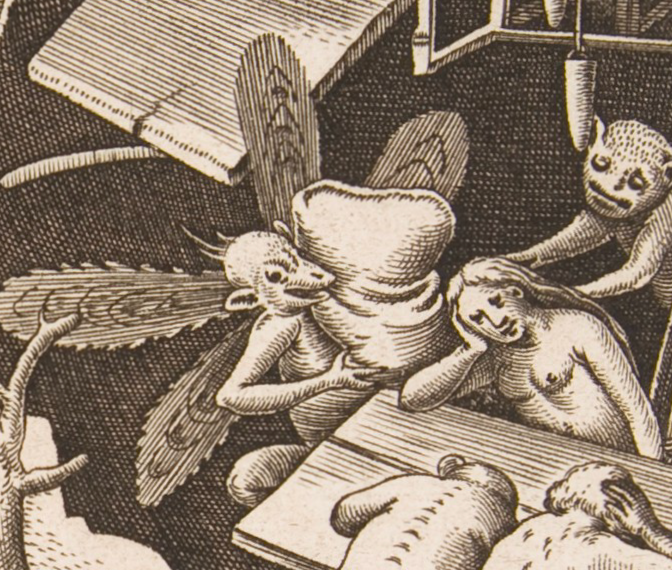
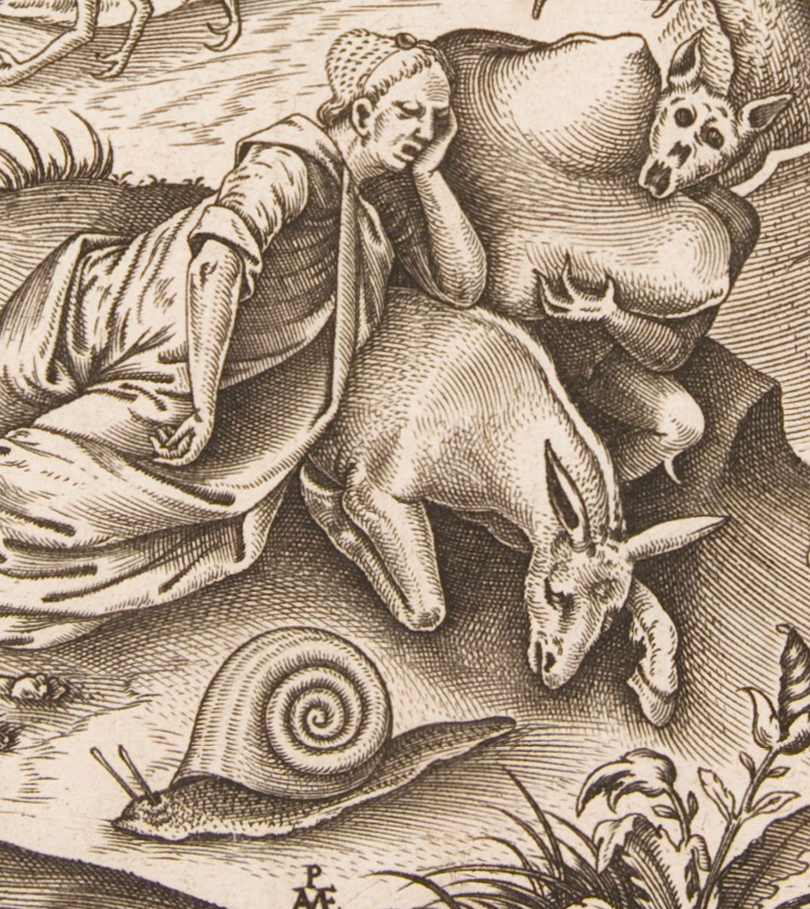
Pieter Bruegel the Elder, Sloth (Desidia), 1558,
from The Seven Deadly Sins series, https://www.metmuseum.org/art/collection/search/338700
These demons are making sure two women are plenty comfortable as they shirk productive uses of their time in favor of sleep. (Sleep is also one of my favorite (mis)uses of my time when I’m depressed! And don’t you just love that giant snail in the second detail? Its connection with acedia/sloth needs no explanation.)
Likewise, this print by Jan Luyken from 1699 shows a devil smiling as he rests his head on the shoulder of personified Indolence, no doubt pleased with himself, just like the demon in Huxley’s essay on acedia:
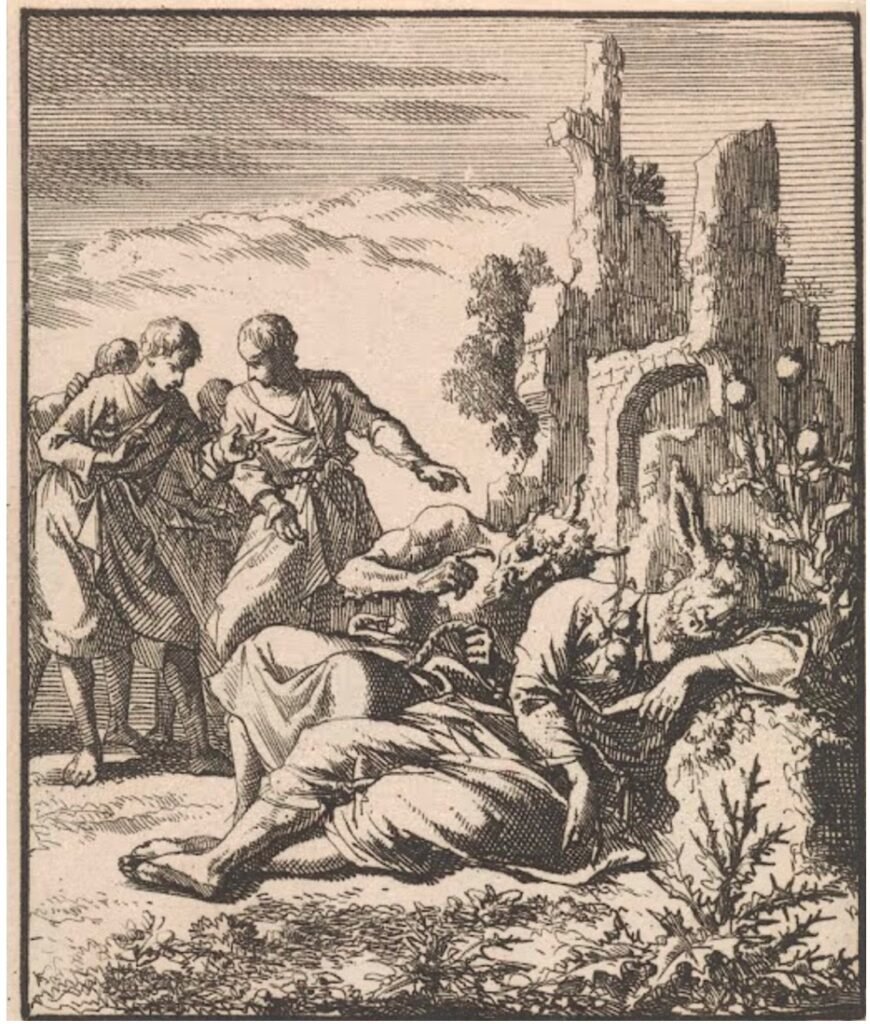
In the Bruegel image, one of the women rests on a sleeping donkey, while Luyken’s Indolence has donkey ears himself. Donkeys have long been associated with foolishness—with being an ass—and that’s what they signal here, as well.
On the other hand, in Pieter Jalhea Furnius’s print Vigilance Conquers Indolence, we see just how damn good it feels to triumph over listless despair:
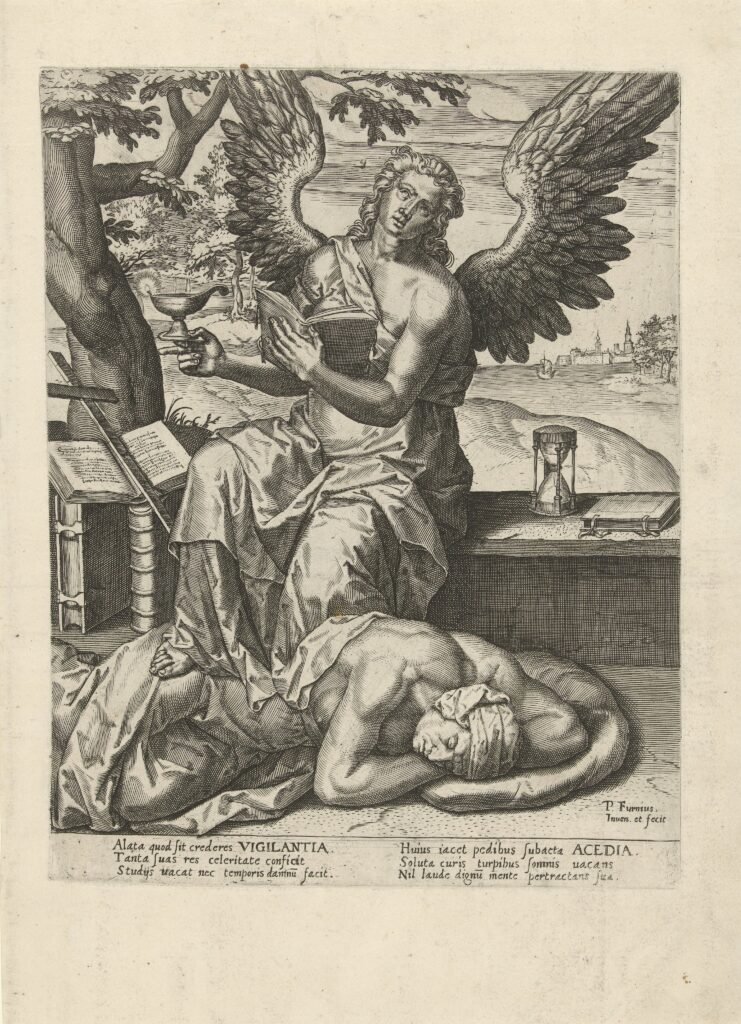
no date, https://id.rijksmuseum.nl/200186889
Here, a figure designated as “Acedia” sleeps on the ground beneath the feet of seated “Vigilantia.” The clock is a tickin’, as the hourglass indicates, but there’s no need to worry, because Vigilance is on the job. She holds one book in her hand, another lies open on the left, and three additional books appear on either side of her. She holds the burning lamp of knowledge in her right hand.
Vigilance: she’s studious, she’s devout (check the cross and her eyes turned to God), she’s got great hair, and town and country flourish around her (compare Vigilance’s setting to the crumbling, weedy surroundings of Luyken’s devil-influenced Indolence). No wonder Vigilance feels like flexing her beautiful I’m-a-personification wings.4
In Huxley’s essay that I quoted above, he traces attitudes toward acedia from the Middle Ages through the nineteenth century, when the Romantics (think Lord Byron, Baudelaire, Percy and Mary Shelley) ushered in a sea change in acedia’s reputation:
Then came the nineteenth century and romanticism; and with them the triumph of the meridian [noonday] demon. Accidie [acedia] in its most complicated and most deadly form, a mixture of boredom, sorrow and despair, was now an inspiration to the greatest poets and novelists, and it has remained so to this day. […] It is a very curious phenomenon, this progress of accidie from the position of being a deadly sin, deserving of damnation, to the position first of a disease and finally of an essentially lyrical emotion, fruitful in the inspiration of much of the most characteristic modern literature.5
The Romantics recognized that acedia has an alluring aspect, a certain siren-song quality, because it can be the flipside or motivator of artistic productivity. The sensitive soul, the deep thinker, the artist: all are especially susceptible to acedia.
But I think Huxley places the origin of the romanticization of acedia too late in time. One can see a new attitude toward the noonday demon as far back as the sixteenth century in a work by the pathbreaking Albrecht Dürer:
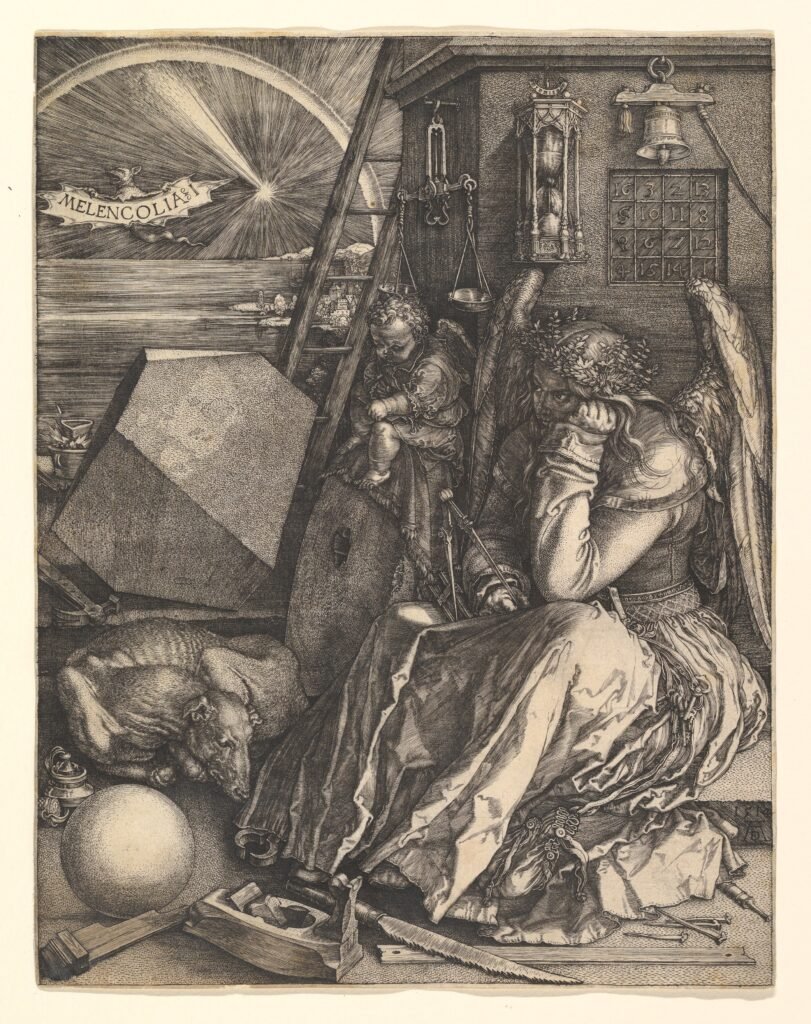
This is Dürer’s 1514 Melencolia I, one of the three engravings considered his Meisterstiche (Master Prints) because of their virtuosity and iconographic complexity.6
Dürer depicts the personified Melancholy as an artist or architect with the tools of her trade around her. She holds her head in her hand, just like the acedia-sufferers we saw above in the print designed by Pieter Bruegel; her body language communicates her struggles with her work. She is lost in thought with a fierce, distant gaze and her compass poised for the moment inspiration strikes—whenever that may be.
For me, what makes this print surprisingly hopeful is the tension between subject matter and form: winged Melancholy may be suffering the pangs of acedia, but her maker, Dürer, produced this image in the opposite state, during a triumphant application of his abilities. To create this, he pushed through his own moments of artistic blockage and self-doubt.
It’s an encouraging juxtaposition.
Acedia, melancholy, listless despair: we all experience them at one time or another. But if we keep going anyway, we can create wonders—wonders, like Melencolia I, which are all the more moving because of their familiarity with these most human of lows.
[1] For Aquinas’s biography and more on his writings, see Robert Pasnau, “Thomas Aquinas,” Stanford Encyclopedia of Philosophy (Winter 2024 edition), ed. by Edward N. Zalta and Uri Nodelman, https://plato.stanford.edu/archives/win2024/entries/aquinas/.
[2] Thomas Aquinas, The Summa Theologica of Saint Thomas Aquinas, Vol. 2, Great Books of the Western World, translated by Fathers of the English Dominican Province, revised by Daniel J. Sullivan (Encyclopædia Britannica, Inc., 1923), 563, Internet Archive, https://archive.org/details/in.ernet.dli.2015.462789.
[3] Aldous Huxley, On the Margin: Notes and Essays (Chatto and Windus, 1923), 18–19, Internet Archive, https://archive.org/details/in.ernet.dli.2015.173594. Don’t you just adore Huxley? He’s so casually brilliant—a great thinker who still manages to be approachable. Love that.
[4] As is common with personifications of abstract concepts, both Acedia and Vigilance are women (despite their rippling muscles—thanks a lot for THAT trend, Michelangelo). I’ve always found it fascinating that personifications tend to be women. It’s as though women are easier to empty of their own meaning, which makes them better vessels than men for signifying vague concepts like Victory or Fortune (at least for male artists). Perhaps a topic for a future blog post!
[5] Huxley, On the Margin, 22.
[6] Dürer’s other two Master Prints are Knight, Death, and the Devil, https://www.metmuseum.org/art/collection/search/336223 and St. Jerome in His Study, https://www.metmuseum.org/art/collection/search/336229.Thousands of pages have been written on these three prints alone, but I still like to go back to Erwin Panofsky’s erudite yet approachable discussion of them in Albrecht Dürer, vol. 1(Oxford University Press, 1945), 151–71, Internet Archive, https://archive.org/details/dli.ministry.00161.
Congrats on the blog!